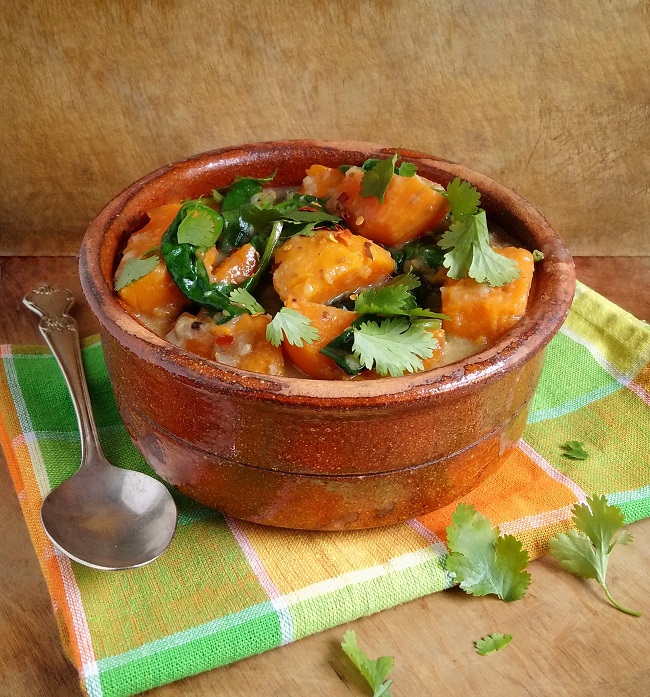
Sweet potato, spinach and coconut stew (gluten-free; dairy-free; vegan)

Sweet_potato_spinach_and_coconut_stew
Sweet potato, spinach and coconut stew. Image: Kathryn Hawkins

A deliciously fragrant and comforting recipe for you this week. An old favourite of mine which works just as well with potatoes if you’re not a fan of the sweet variety. It makes a good side dish, but I usually serve it as a main course, spooned over rice.
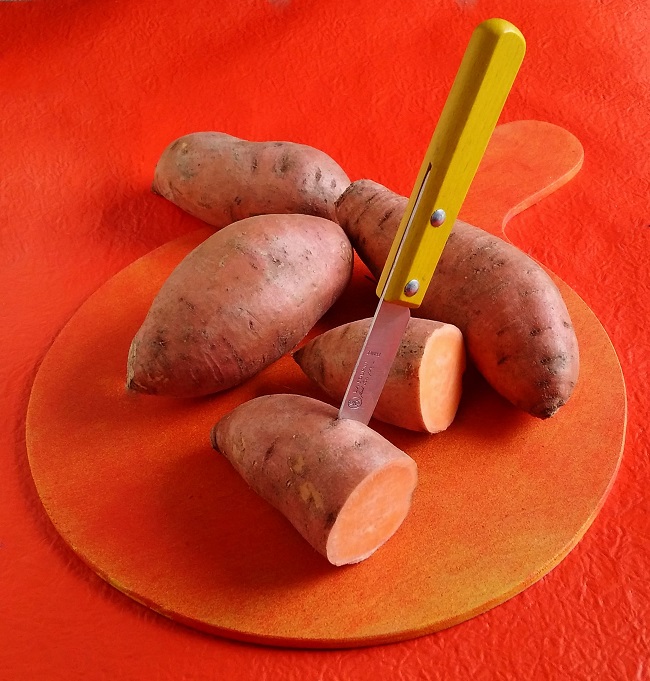
Fresh_sweet_potatoes
Preparing sweet potatoes. Image: Kathryn Hawkins

The stew is very easy to make. You can change the proportions of the individual spices to suit your taste. The overall flavour is reminiscent of a green Thai curry without the lemongrass or lime leaves. I’m not a huge chilli fan, I like a hint of heat rather than a major blast, so you may want to increase the chilli-factor for more of a spicy kick. If you have fresh green chillies, grind them up in the spice paste as an alternative to using the dried flakes.

If you have any leftover, the stew makes a good soup the next day. Just blend it up in a food processor with stock or more coconut milk. I hope you enjoy it 🙂
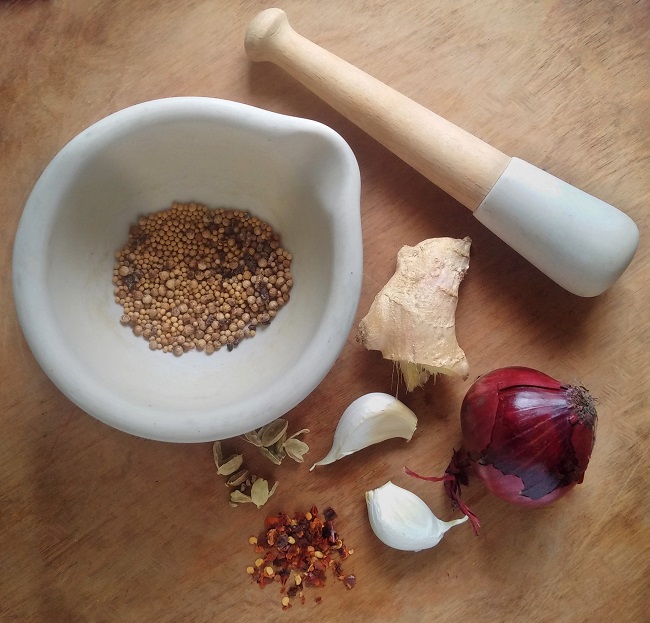
Collection_of_spices_to_make_a_spice_paste
Spice paste ingredients. Image: Kathryn Hawkins

Serves: 4

Ingredients

  • 6 cardamom pods
  • 1 teasp each of coriander and mustard seeds
  • 1 small red onion or shallot
  • 2 garlic cloves
  • 3cm piece root ginger
  • Dried chilli flakes, to taste
  • 2 tbsp. vegetable oil
  • 400ml canned coconut milk
  • 650g sweet potatoes, peeled and cut into 3cm thick chunky pieces
  • 225g prepared spinach
  • 1 teasp salt
  • A small bunch fresh coriander, roughly chopped
  1. Remove the green casing from the cardamom pods and put the seeds in a pestle and mortar along with the coriander and mustard seeds. Lightly crush them, then toast them in a small frying pan, over a medium heat, for 2-3 minutes until fragrant and lightly toasted but not brown. Leave to cool.
  2. Peel and roughly chop the onion, garlic and ginger and place in a food processor or blender. Add 1 tbsp. oil and the toasted spices and chilli flakes to taste. Blend for a few seconds to make a paste.
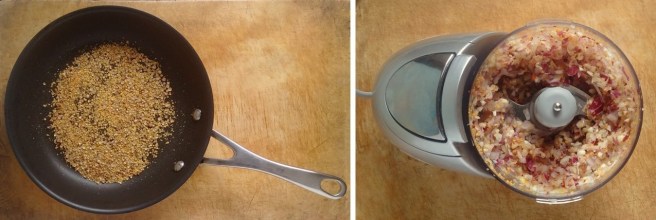
    Toasting_spice_seeds_in_a_small_frying_pan_and_blending_ingredients_to_make_a_spice_paste
    Toasting spices and making a spice paste. Image: Kathryn Hawkins
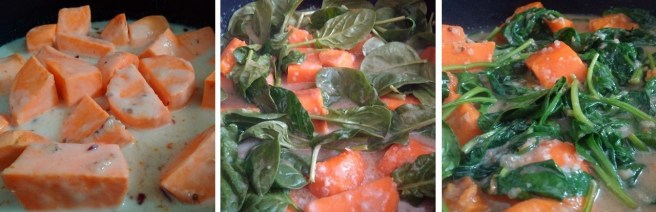
  3. Heat the remaining oil in a large, deep-sided frying pan or wok and gently fry the paste for about 5 minutes until softened but not browned. Pour over the coconut milk, bring to the boil, and stir in the sweet potato pieces. Bring back to the boil, cover, reduce the heat and simmer gently for about an hour until tender.
  4. Add the spinach in batches, stirring well to make sure it gets completely coated in the coconut liquor. Add the salt, cover and continue to cook gently for a further 10 minutes, stirring occasionally, until then spinach is wilted and the sauce is thick.
    3_steps_to_cooking_sweet_potato_and_spinach_stew
    The 3 stages of stew. Images: Kathryn Hawkins


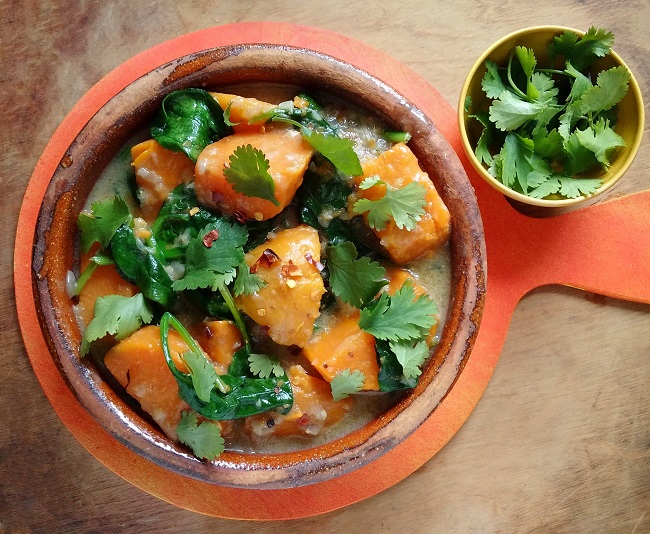
  5. To serve, sprinkle the stew with a generous amount of chopped, fresh coriander, and extra chilli if liked. Serve immediately,  spooned over rice.
    Serving_bowl_of_sweet_potato_coconut_and_spinach_stew
    Sweet potato stew, ready to serve. Image: Kathryn Hawkins


Vanilla bean torte (gluten-free; dairy-free; vegan)


Vanilla_bean_torta
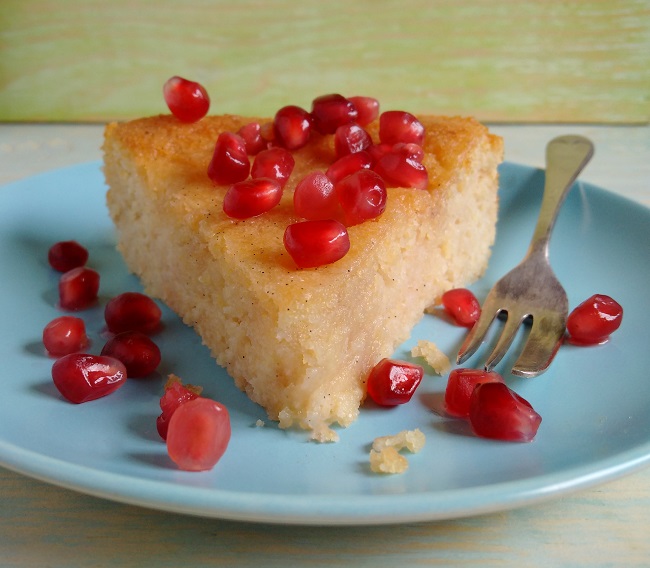
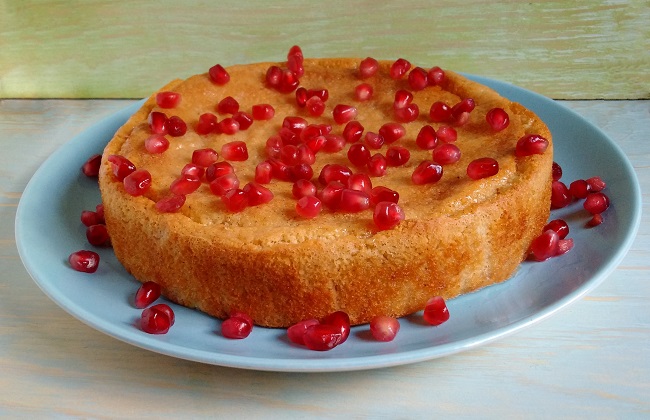
Vanilla bean torte. Image: Kathryn Hawkins

I’m always on the look-out for interesting bakes. I have a large folder of recipe articles saved from magazines and newspapers going back many years, along with various scraps of note paper, tucked in between, containing my culinary jottings from articles that have taken my fancy. Every now and then I go through the folder and decide which idea to experiment with next.

And so to this week’s post. A cake that came to my attention a few months ago when I was experimenting in the kitchen and making vegan meringue from the canning water in a tin of beans. This recipe uses the beans as well as the canning liquid. Sounds weird, but eating is believing, and I was pleasantly surprised by the texture and how good it tasted.

A_slice_of_vanilla_bean_torta
Vanilla bean torte, sliced and ready for eating. Image: Kathryn Hawkins
Canned_and_drained_cannellini_beans
Canned cannellini beans for cake-making. Image: Kathryn Hawkins
Apart from the beans, the other ingredients are mainstream. The flavour can be varied depending on your preference. I used a generous amount of vanilla paste, but fresh orange and lemon rind would work well, as would almond extract if you like a marzipan flavour. I think the mixture could take about 15g cocoa powder added to it for a chocolate version. My cake is soaked in a vanilla flavoured syrup but the syrup can be adapted to suit your chosen cake flavour. There is no added fat or oil in the recipe which makes the syrup an important addition as it not only adds extra sweetness and flavour, but it helps keep the cake moist too. I hope you enjoy it 🙂

Serves: 8-10

Ingredients

  • 400g can cannellini beans in water
  • 50g polenta
  • 75g silken tofu
  • 215g caster sugar
  • 55g ground almonds
  • 1 tbsp vanilla bean paste
  • Pomegranate seeds to decorate
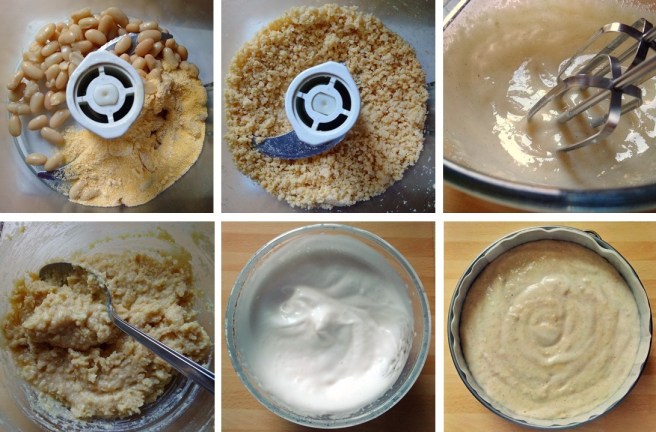
  1. Preheat the oven to 180°C (160°C fan oven, gas mark 4). Grease and line an 18cm diameter cake tin. Open the can of beans and drain well, reserving the canning liquid. Put the beans in a blender or food processor. Add the polenta and blitz for several seconds until well ground. Leave to one side.
  2. Whisk the tofu with 115g sugar until well blended and creamy. Add the ground almonds, half the vanilla paste and the ground bean mixture and stir to form a thick cake batter.
  3. In another bowl, whisk the bean canning liquid until stiff and foamy, then gently fold this into the cake batter. Transfer to the prepared tin, smooth the top and bake for about 1 to 1 ¼ hours, until golden and firm to the touch.

    Step_by_step_pictures_to_make_a_bean_torta
    Making bean torte. Images: Kathryn Hawkins
  4. While the cake is in the oven, prepare the syrup. Put the remaining sugar in a small saucepan and add 150ml water. Heat, stirring, until the sugar dissolves then bring to the boil and simmer for 8-10 minutes, until reduced and syrupy. Remove from the heat and stir in the remaining vanilla paste. Keep warm.
  5. Once the cake is cooked, skewer the top all over and slowly pour over the vanilla syrup so that it soaks into the cake evenly. Leave to cool completely in the tin.

    3_steps_to_making_and_adding_vanilla_syrup
    Making and adding vanilla syrup. Images: Kathryn Hawkins
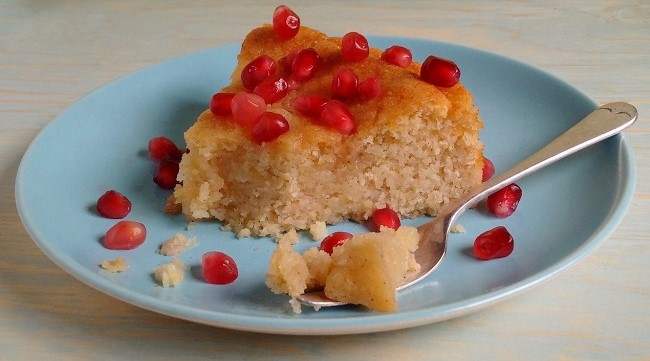
  6. To serve, carefully remove the cake from the tin and place on a serving plate. Sprinkle with pomegranate seeds just before slicing. The cake will keep, covered, in a cool place or the fridge, for 3 to 4 days.
    Overhead_image_of_vanilla_bean_torta_sprinkled_with_pomegranate_seeds
    Decorating the torte with pomegranate seeds. Image: Kathryn Hawkins
    A_single_serving_of_vanilla_bean_torta
    Vanilla bean torte, deliciously moist and full of flavour. Image: Kathryn Hawkins
 

Mini sco-nuts (gluten-free; dairy-free; vegan)

Tray_of_warm_vanilla_sugar_sprinkled_sco-nuts
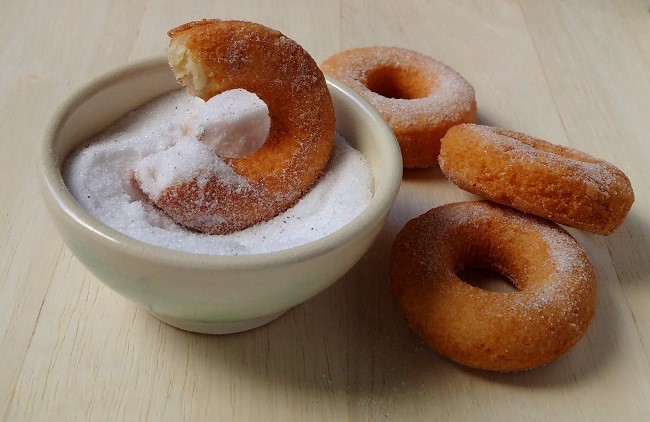
Vanilla sugar-dredged mini sco-nuts. Image: Kathryn Hawkins

The weather has turned colder this past week, and my thoughts have turned to comfort food. In my opinion, food doesn’t come much more comforting than a light, fluffy doughnut with a crunchy, sugary coating. Sadly, not usually a choice for anyone on a gluten-diet, but I think these little treats are a good alternative, and best of all, they can be made in a fraction of the time that it takes to make the real thing.

Close-up_of_a_mini_ring_sco-nut_coated_in_vanilla_sugar
Mini sco-nut, fresh out of the pan. Image: Kathryn Hawkins

As the name suggests, the recipe derives from a scone mix that is cut and fried like a doughnut. I coated mine in home-made vanilla sugar but plain sugar is just as good. Leave them plain and dip them in a little of your favourite jam or sweet dipping sauce. Sometimes, I drizzle them with a little vanilla or cocoa flavoured glacé icing and decorate with a few sprinkles.

Mini_sco-nuts_drizzled_with_icing_and_decorated_with_sprinkles
Drizzled and decorated, mini sco-nuts. Image: Kathryn Hawkins
Pot_of_home-made_vanilla_sugar
Home-made vanilla sugar. Image: Kathryn Hawkins

I always have a pot of vanilla sugar in the cupboard. I chop up bits of vanilla pod that is past its prime, or any part of the pod that has dried out, and just keep topping up the pot with caster sugar. Every now and then I give the pot a shake to distribute the vanilla pieces, and I keep the pot well sealed. You do need to sieve it when you use it, but keep the bits of pod trapped in the sieve and put them back in the pot along with a top up of sugar, and you can replenish your supply more or less indefinitely. Here’s the recipe.

Makes: 14 mini sco-nuts

Ingredients

  • 150g gluten-free self-raising flour (such as Dove’s Farm)
  • 5g gluten-free baking powder (such as Dr Oetker)
  • 2g xanthum gum, optional – I have started adding this to my scone mixture as it really does improve the crumb texture
  • 25g caster sugar
  • 2 tbsp sunflower oil + extra oil for deep-frying
  • 1 teasp good quality vanilla extract
  • Approx. 6 tbsp. soya or other non-dairy milk
  • Vanilla sugar or caster sugar to dredge
  1. Sieve the flour, baking powder and xanthum gum into a bowl and stir in the caster sugar. Make a well in the centre, and spoon in the oil and vanilla, then bind together with sufficient milk to form a softish scone dough.
  2. Pour the oil for deep-frying into a saucepan or wok and begin heating – the oil temperature needs to be around 180°C to fry the sco-nuts properly. While the oil is heating, turn the dough out on to a lightly floured surface and knead gently to bring the mixture together and make smooth, then roll or press to a thickness of 1cm.
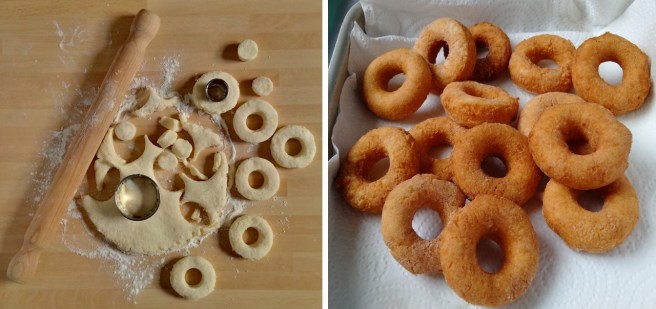
  3. Cut out rounds using a plain 5cm cookie cutter, and press out the middles using a 2cm round cutter. Re-roll the trimmings nd middles to make 14 mini rings in total.
  4. Fry the sco-nuts in 2 batches, turning them gently in the oil, for 2-3 minutes, until golden and crisp all over. Drain well on kitchen paper and keep warm while cooking the second batch.
    Sco-nut_dough_shaping_and_after_frying
    Preparing and cooking mini sco-nuts. Images: Kathryn Hawkins

    Dredge in sugar if liked, or drizzle with icing. Best served while still warm. Sco-nuts do freeze well if you have any leftover; just bag them up, seal and freeze. You can reheat them gently in a moderate oven for about 5 minutes if you want to eat them warm.

    Warm_sco-nuts_being_dipped_in_vanilla_sugar
    Extra indulgence, dipping mini sco-nuts in vanilla sugar. Image: Kathryn Hawkins
 

Baked vanilla pears with chocolate “butter” (gluten-free; dairy-free; vegan)

Bowl_of_freshly_picked_home-grown_Comice_pears
Home-grown Comice pears. Image: Kathryn Hawkins
I’ve had a very “light” pear harvest this year. In fact, just 4 fruit developed on one tree and the other had no fruit at all. Not sure why, the spring was fine, there was so much blossom and plenty of bees around to pollinate it. Perhaps the pear trees decided to have a bit of a holiday this year.

Comice_pears_growing_just_before_picking
Just before harvest. Image: Kathryn Hawkins

So with such a precious harvest, what to cook? I picked the pears a couple of weeks ago, and they have been ripening gently and slowly in a cool spot in the kitchen. They remained quite firm, so I decided I would cook them.

Bowl_of_baked_pears_with_chocolate_"butter"
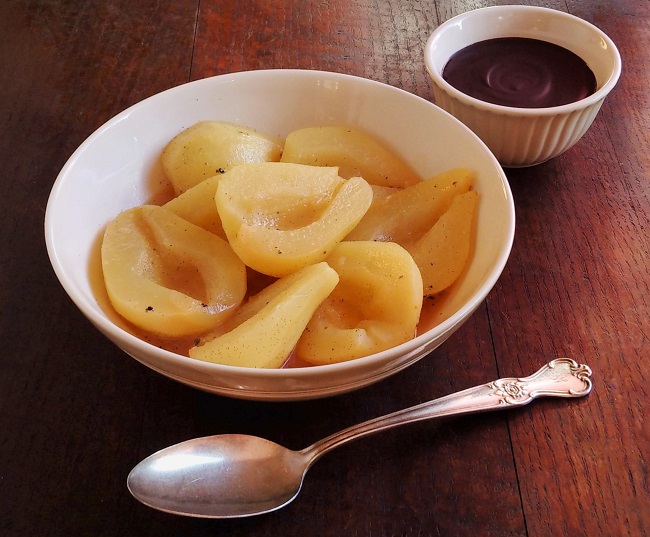
Vanilla baked pears with chocolate “butter”. Image: Kathryn Hawkins
Vanilla is one of my favourite spices, and it is a particularly delicious flavouring for pears. This is a very simple recipe, but it tastes a little bit more special because the pears are cooked in Moscatel de Valencia – the floral notes of this sweet Spanish wine are a perfect match for both pears and vanilla.

Chocolate is another “must have” with pears as far as I’m concerned, and this easy “butter” makes an interesting alternative to the usual chocolate sauce. Moscatel is one of the few wines I think goes well with chocolate, so this is a “win win” recipe for me. Serve the pears very slightly warm or at room temperature so that the cooking juices don’t  begin to set, and avoid chilling the chocolate accompaniment (unless the room temperature is very warm) as it will become very hard to spoon.

Serves: 4

Ingredients

  • 4 firm pears
  • Juice of ½ a lemon
  • 1 vanilla pod
  • 300ml Moscatel  de Valencia wine (or white grape juice if preferred)
  • 1 tbsp. agave syrup (or clear honey if you eat it)
  • 40g dairy-free margarine (or unsalted butter)
  • 100g dairy-free 85% cocoa chocolate
  • 50g golden syrup
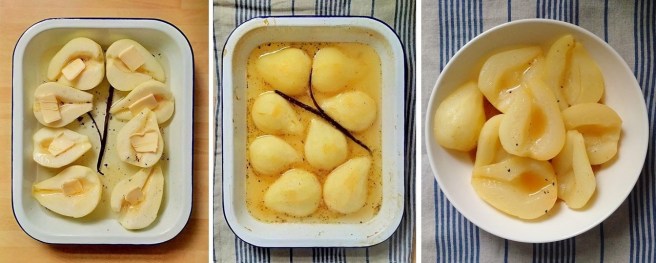
  1. Preheat the oven to 180°C (160°C fan oven, gas 4). Peel and core the pears, and cut in half. Brush lightly with lemon juice and place cut-side up in a shallow baking dish.
  2. Split the vanilla pod and scoop out some of the seeds using the tip of a sharp knife. Push the rest of the pod into the dish of pears, mix the scooped-out seeds with the wine and pour over the pears.
  3. Dot the pears with 15g of the margarine and drizzle with agave syrup. Cover with foil and bake for 30 minutes. Remove the foil, turn the pears over, baste with the cooking juices, and return to the oven to bake, uncovered, for a further 20 minutes or until the pears are tender.
  4. Cool for 30 minutes in the cooking juices, discard the vanilla pod, then lift out the pears using a slotted spoon and place in a heatproof dish. Pour the cooking juices into a small saucepan.
  5. Bring the cooking juices to the boil and simmer for about 5 minutes until reduced by half. Pour over the pears and leave to cool.

    Steps_to_preparing_baked_pears_with_vanilla
    Preparing baked pears with vanilla. Images: Kathryn Hawkins
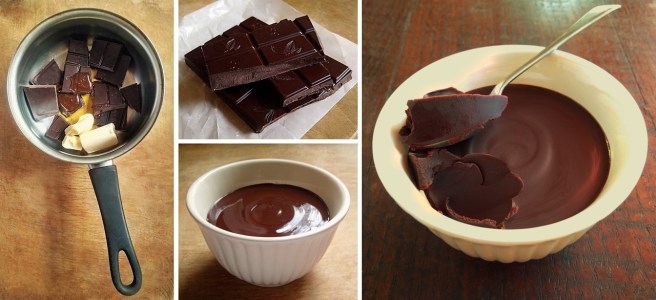
  6. For the chocolate “butter”, break the chocolate into pieces and put in a saucepan with the remaining margarine and the golden syrup. Heat very gently, stirring, until melted. Remove from the heat, mix well and pour into a small, heatproof dish. Leave to cool – the “butter” will solidify when it becomes cold.
    How_to_make_chocolate_"butter"
    Making chocolate “butter”. Images: Kathryn Hawkins

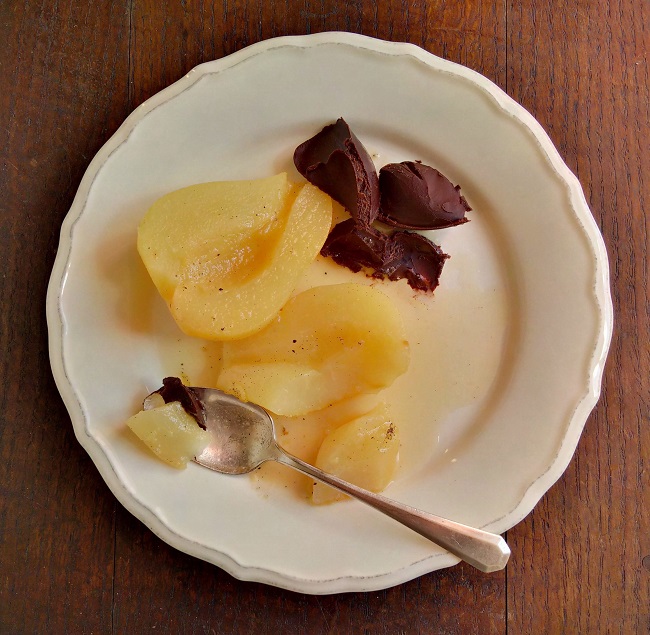
    Serve the pears at room temperature accompanied with the chocolate “butter”. If you prefer, leave the chocolate mixture to cool for about 30 minutes and serve warm as a thick, glossy chocolate sauce.

    Single_serving_of_vanilla_baked_pears_with_chocolate_"butter"
    Vanilla baked pears with chocolate “butter”. Image: Kathryn Hawkins
Tutti frutti loaf cakes (gluten-free, dairy-free, vegan, no added sugar)

Mini_gluten-free_vegan_fruit_loaf_cakes
Tutti frutti loaf cakes. Images: Kathryn Hawkins
No eggs, no added fat nor added sugar, gluten-free and dairy-free, these loaf cakes will probably sound either a bit boring, or too good to be true, depending on your point of view. Actually, they are extremely tasty and a wee bit too eatable for my liking!

This recipe is a great way to use up all those odds and ends of dried fruit you often have leftover. You can add nuts and seeds to the mix too if you like. Just after Christmas, I made up a bag of dried and candied fruit that was getting towards its use-by date, and put it in a tub the freezer, where it stayed until this week, when a craving for fruit cake came upon me. Combined with a recently opened bag of dried cranberries I had in the fridge, the frozen mix of chopped dried apricots, red and green glacé cherries and golden sultanas made up a colourful addition to my cake mix.

Combination_of_sultanas_candied_cherries_and_apricots
Post-Christmas homemade tutti frutti mix. Image: Kathryn Hawkins
The recipe below will fill 8 mini loaf tins or 1 large (1kg) loaf tin. The cakes taste better if left until the day after baking – the flavour and texture improves on keeping. You will be rewarded if you can leave it alone for a few hours! They also freeze well. I find that the lower content of fat in this recipe means that after 3 or 4 days, the cakes begin to lose their freshness; it is well worth freezing any that you’re not going to eat within a couple of days of baking, in order to enjoy them at their best.

8_individual_loaf_tins
Mini loaf tins. Image: Kathryn Hawkins
 

Makes: 8 minis or 1 x 1kg loaf

  • 250g stoned dried dates, chopped
  • 2 tsp good quality vanilla extract
  • 150g gluten-free plain flour blend (such as Dove’s Farm)
  • 15g gluten-free baking powder (such as Dr Oetker)
  • 10g arrowroot
  • 2 tsp chai masala or ground mixed spice
  • 75g ground almonds
  • 500g mixed dried and candied fruit
  1. Preheat the oven to 170°C (150°C fan oven, gas mark 3). Grease 8 x mini loaf tins or 1 x 1kg loaf tin, or line with paper loaf tin liners, if preferred. Put the chopped dates in a saucepan and pour over 350ml water. Bring to the boil, simmer for 2 minutes, then turn off the heat and leave to cool completely. Blitz with a hand blender or in the food processor to make a smooth purée. Stir in the vanilla extract.
  2. Sieve the flour, baking powder, arrowroot and chai masala or spice into a bowl and stir in the ground almonds and dried fruit. Add the date purée and then mix until well blended.
  3. Divide equally between the prepared tins and smooth over the tops. Place on a baking tray and bake for about 35 minutes for the individual cakes or about 1 hour for a larger loaf cake – a skewer inserted into the centre will come out clean when the cake mixture is cooked. Cool for 10 minutes, then turn onto a wire rack to cool completely.  For best results, wrap the cakes well or store in an airtight container until the next day before serving.
Tutti_frutti_cake_mix_divided_between_8_mini_loaf_tins
Tutti frutti cake mix ready for baking. Image: Kathryn Hawkins
Inside_a_tutti_frutti_loaf_cake
Packed full of colour and flavour. Image: Kathryn Hawkins


Chai masala biscuits for Easter (gluten-free, dairy-free, vegan)

Chai_masala_spiced_Easter_biscits
Marzipan-topped chai masala biscuits for Easter. Image: Kathryn Hawkins
Rich, short, lightly fruited biscuits with a hint of spice, this is a spring bake that takes me back to my childhood. Easter just wouldn’t be Easter without them. Traditionally the biscuits are dusted with white sugar before baking to give them a crusty top, but I love marzipan and it makes a delicious topping for these biscuits. Using a chai masala mix instead of the usual ground spice blends adds a delicate citrus note to the flavour. I think this Indian spice mix tastes lighter and more fragrant than the more familiar blends used in baking.

Jar_of_ready_mixed_chai_masala
Ready blended chai masala mix. Image: Kathryn Hawkins
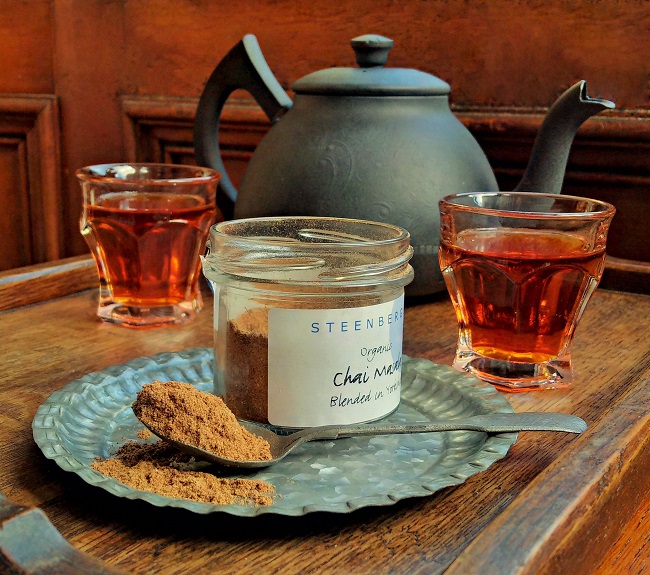
You can buy ready mixed chai masala for putting in your bakes (or tea!) (Steenbergs organic chai masala), but if you have selection of traditional spices, it is easy enough to put together your own blend. Making your own means that you can experiment by adding more of your favourite spice to personalise your mix.
Selection_of_whole_spices_that_make_up_a_chai_masala_blend
Whole spices: root ginger, nutmeg, cinnamon, black pepper, cloves and cardamom. Image: Kathryn Hawkins

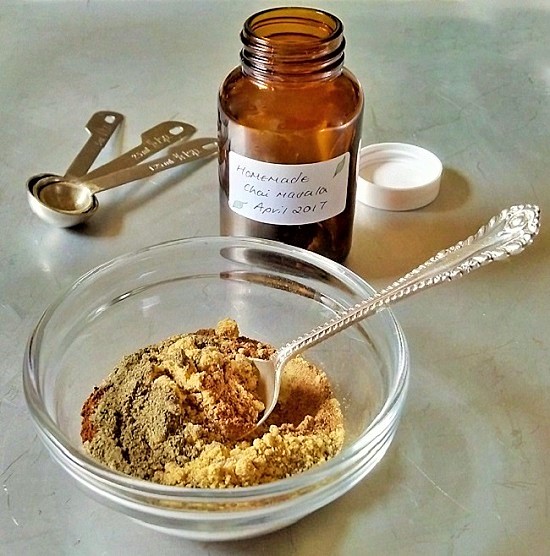
To make your own chai masala, mix together 4 level teaspoons ground cinnamon, 2 level teaspoons ground cardamom, 1 level teaspoon ground ginger and ½ level teaspoon each ground nutmeg, ground cloves and finely ground black pepper. As with all spices, store in a sealed jar out of direct sunlight, in a cool, dry place. I keep small vitamin supplement jars for keeping spice mixes in as the glass is often brown or dark green, and so perfect for keeping out the light. Make up the blend in small batches  to insure fresh flavour every time you use it. Chai masala can be used in any recipe where a ground mixed spice is called for.

Making_homemade_chai_masala_spice_mix
Blending together ground spices for chai masala. Image: Kathryn Hawkins

Here’s the recipe for my Easter biscuits.

Makes: 14

  • 100g vegan margarine, softened (use butter if you prefer)
  • 75g caster sugar
  • 3 tbsp non dairy milk
  • 200g gluten-free plain flour blend + extra for dusting (such as Dove’s Farm)
  • 1 ½ to 2 tsp chai masala
  • 65g mixed currants and chopped cranberries
  1. Line 2 large baking trays with baking parchment. Put the margarine  and sugar in a bowl and whisk together until smooth and creamy. Whisk in the milk.
  2. Sift the flour and spice on top and add the fruit. Mix all the ingredients together until well combined, then bring the mixture together with your hands to make a softish dough.
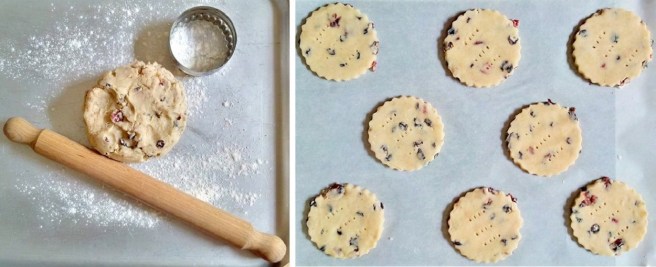
  3. Dust the work surface with flour and knead the dough gently until smooth. Roll out thinly to a thickness of approx. ½ cm. Using a 7cm crinkle-edge round cutter, stamp out 14 rounds, re-rolling the dough as necessary. Arrange the rounds on the baking trays, spaced a little apart. Prick with a fork, and chill for 30 minutes.

    Biscuit_dough_rolling_and_shaping
    Preparation of the biscuit dough. Images: Kathryn Hawkins
  4. Preheat the oven to 200°C (160°C fan oven, gas mark 6). Bake the biscuits for about 15 minutes until lightly golden round the edges. Cool on the trays for 5 minutes, then transfer to a wire rack to cool completely.

    Baked_chai_spiced_Easter_biscuits
    Freshly baked chai spiced Easter biscuits. Image: Kathryn Hawkins
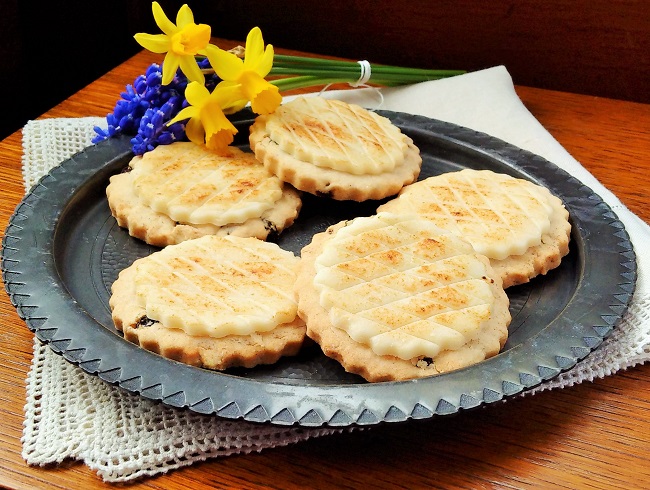
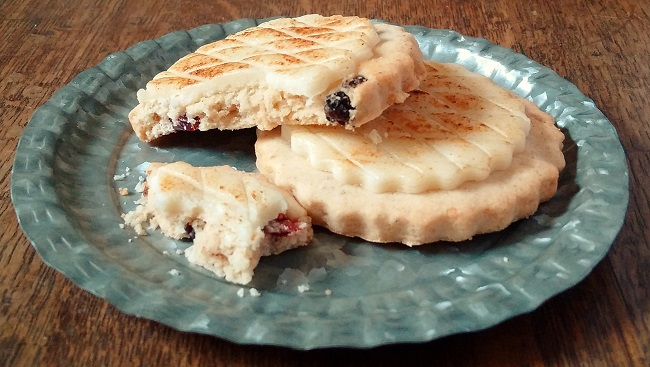
  5. The biscuits are delicious left plain but if you are a marzipan fan, dust the work surface with icing sugar and roll out 200g marzipan thinly. Using a 6cm diameter crinkle-edged cutter, stamp out 14 rounds, re-rolling the marzipan as necessary. Brush each biscuit with a little smooth apricot jam and secure a marzipan disc on top of each. Score the marzipan with a knife and lightly toast the tops with a cook’s blow-torch if liked. Happy Easter eatings!

Chai_masala_spiced_Easter_biscuits_with_marzipan_top
Marzipan-topped Easter biscuits. Image: Kathryn Hawkins


Baked coconut apples (gluten-free, dairy-free, vegan)

Cooking_apple_harvest
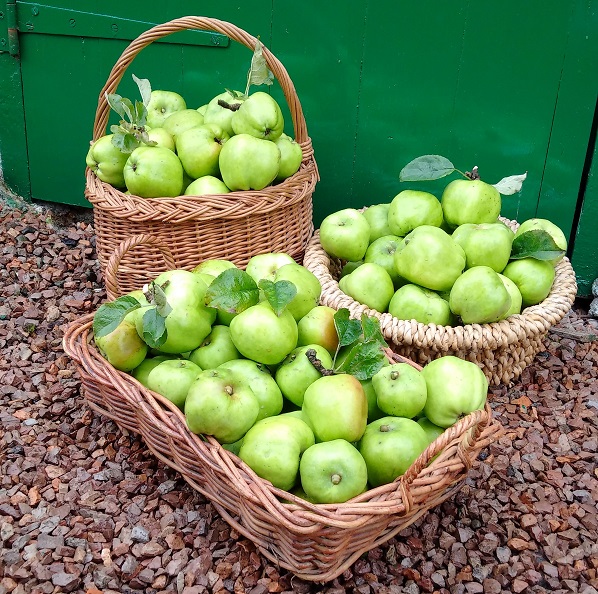
Late September harvest Lord Derby cooking apples. Image: Kathryn Hawkins

It seems like a long time ago since I picked all these apples from the aged tree in my garden. I still have plenty, stored in a fridge in the back kitchen, and every now and then I bake something suitably fruity. My apple store makes the perfect “turn-to” choice when the fruit bowl is running low, and cooked apple is so very comforting when it’s cold outside.

This variety of cooking apple, Lord Derby, is not particularly tart or exceptionally flavoursome but it retains texture when cooked which makes it the perfect choice for baking. I have often eaten the smaller ones like a crisp eating apple and they taste rather like a Granny Smith.

My recipe this week is a very simple dessert which tastes as good warm as it does at room temperature. I often bake a batch to have for breakfast accompanied with coconut milk yogurt. Delish 🙂 Add ground cinnamon or cardamom for a more seasonal flavour. If you don’t like or can’t eat coconut, vegetable margarine (or butter) is fine to use, and replace the coconut flakes with your favourite nuts or seeds, or use dried cranberries for a fruitier alternative.

Makes 6 – 8 servings

  • Juice of 1 lemon
  • 750g cooking apples
  • 75g coconut oil, melted (if you are not dairy-free, unsalted butter works well)
  • 50g Demerara sugar
  • ½ – 1 tsp ground vanilla pod (use a clean, old pepper mill/grinder and put chopped up dry vanilla pods inside – it works so well ground over fruit for baking)
  • A handful of raw coconut flakes
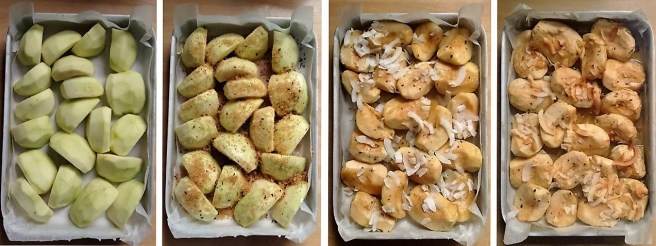
  1. Preheat the oven to 180°C (160°C fan oven, gas mark 4). Line a large shallow baking dish with baking parchment. Pour the lemon juice into a mixing bowl and half fill with cold water.
  2. Peel and core the apples. Cut into thick wedges. Put the prepared apple wedges in the lemony water and mix well – this will help keep the apples from discolouring too much. Drain the apples and blot dry with absorbent kitchen paper.
  3. Arrange the apple wedges on the baking tray and brush all over with the coconut oil. Sprinkle with the sugar and vanilla.
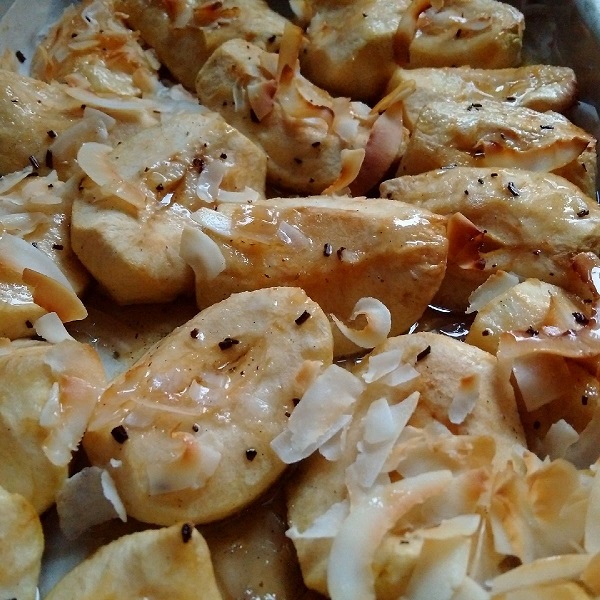
  4. Bake for 20 minutes, turning halfway through. Sprinkle with coconut flakes and continue to bake for a further 20 minutes or until tender and lightly golden. Best served warm with the cooking juices spooned over.
Coconut_baked_apples_step_by_step
Steps to making baked coconut apples. Images: Kathryn Hawkins
Baked_apple_wedges_with_coconut_and_vanilla
Freshly baked coconut apple wedges with vanilla. Image: Kathryn Hawkins


Pear gingerbread cake (gluten-free, dairy-free, vegan)

Storing_Concorde_pears
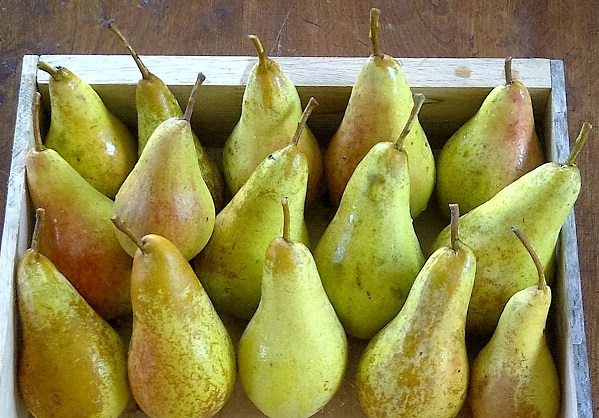
Homegrown Concorde pears. Image by Kathryn Hawkins

The pears I picked a couple of weeks ago are fully ripe now. Most usually, I enjoy them fresh, peeled or unpeeled; occasionally I use a few in cooking. One of my quick “comfort” desserts is to chop pears and mix them with grated marzipan to use as a filling for a gluten-free puff pastry jalousie or plait. Quite delicious.

Today, I’m sharing a recipe for what I call a “proper cake”. In other words, a dense textured cake, neither spongy nor light, but something substantial, and just right for this time of year. Keep it for at least a day after baking to allow the fruit juices to soak into the cake and for the flavours to develop. I use coconut oil and coconut milk a lot in my cookery because I love the flavour; but in this recipe it isn’t noticeable by taste, it simply adds to the richness of the texture. Use another vegetable oil or vegan margarine if you prefer, and a nut, rice or soya milk will work fine as an alternative to coconut milk.

Pears_and_other_ingredients_ready_for_recipe
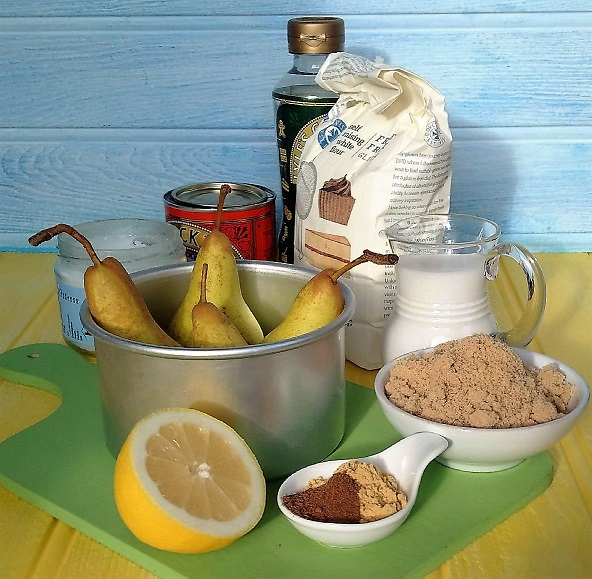
Ingredients for pear gingerbread cake. Image by Kathryn Hawkins

Serves: 6 to 8

  • 75g coconut oil
  • 75g light brown sugar
  • 75g golden syrup
  • 75g treacle
  • 6 tbsp canned coconut milk
  • 150g gluten-free, self raising flour (such as Dove’s Farm)
  • 2 tbsp ground ginger
  • ½ tsp ground allspice
  • 4 small pears
  • Juice ½ lemon
  1. Preheat the oven 170°C (150°C fan oven, gas mark 3). Grease and line a deep, 12cm round cake tine. Put the oil, sugar, syrup and treacle in a saucepan and heat very gently, until melted together. Remove from the heat and stir in the coconut milk. Cool for 10 minutes.
  2. Meanwhile, sift the flour and spices into a bowl and make a well in the centre.
  3. Thinly peel the pears, leaving them whole. Trim away a small slice from the base of each so that they sit upright, and arrange in the cake tin. Brush all over with lemon juice.
  4. Pour the melted ingredients into the spiced flour and mix together to form a thick, smooth batter. Carefully pour into the tin.
  5. Cover the tops of the pears with small pieces of foil to prevent burning. Put the cake tin on a baking tray and bake in the oven for about 1 hour 40 minutes until a skewer inserted into the centre of the cake comes out clean. Discard the foil and leave the cake to cool in the tin completely.

    Pear_gingerbread_cake_in_tin
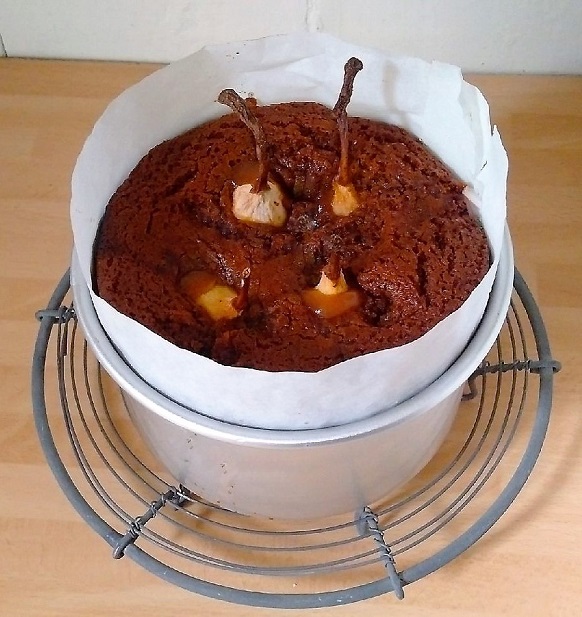
    Just out of the oven, freshly baked pear gingerbread cake. Image by Kathryn Hawkins
  6. Remove from the tin. Wrap in foil and store in a cool place for 24 hours to allow the texture and flavours to develop. Enjoy cold as a cake or, warm slightly and serve as a pudding with dairy free custard.

    Pear_gingerbread_cake_whole_with_slice
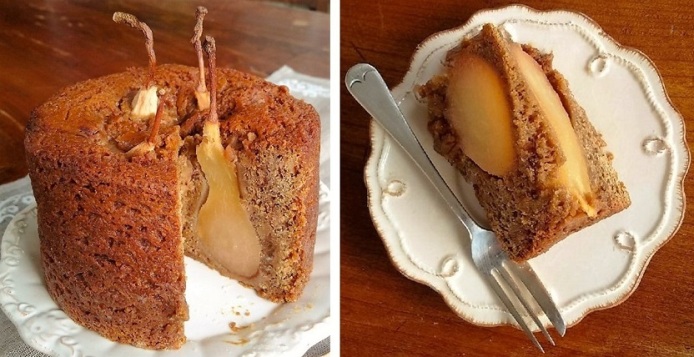
    Pear gingerbread cake. Images by Kathryn Hawkins


Fresh turmeric root – how to grow

Fresh_turmeric_root
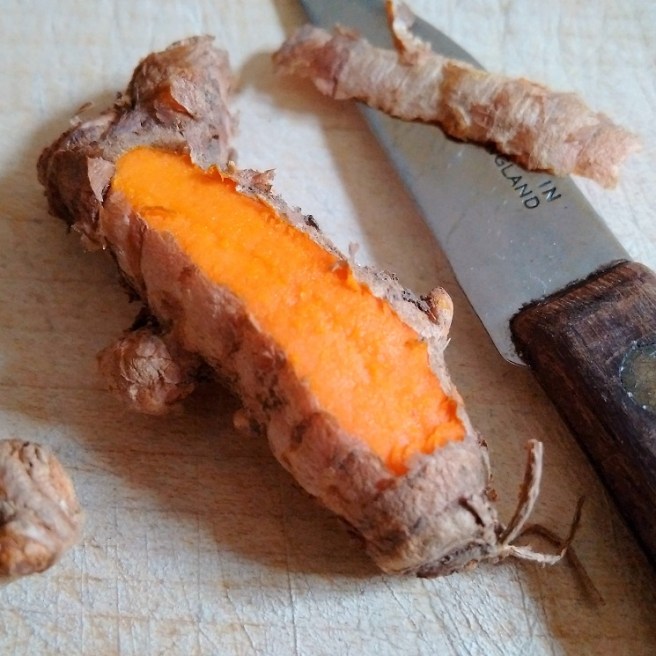
Peeled, fresh turmeric root. Image copyright: Kathryn Hawkins

A few weeks ago, a “foodie” friend came to stay. He lives in rural Yorkshire, and just before he left home to head north to Scotland, he was amazed to find fresh turmeric root in his local village shop.

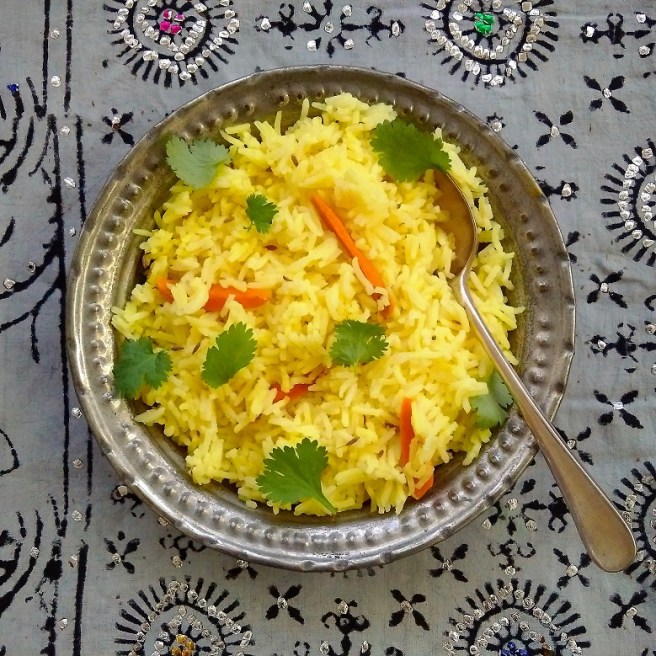
I haven’t cooked with fresh turmeric since I left London, over 12 years ago, so to be gifted some of this wonderful root was a real treat. Turmeric is most usually used as a dry, yellow powder in a curry dish; it has a pleasant fragrant/pungent flavour, and gives a warm glow to whatever it is cooked with. Used fresh, it has the same qualities, but the flavour is more earthy, flowery and mellow. Take care when preparing, as it stains anything it comes into contact with. I peeled the root with a vegetable peeler and cooked a few strips with some Basmati rice (see below – it tasted delicious!). Realising how much I missed this fresh spice, I decided to try to grow the remaining  roots to see if I might have my own fresh supply in the future.

Fresh_turmeric_rice
Cooked Basmati rice with fresh turmeric. Image copyright: Kathryn Hawkins

Keeping in mind that I live in central Scotland, I wondered whether I might have trouble getting germination underway – I discovered that the roots need 20-30°C to get sprouting and I don’t have a heated greenhouse or a propagator. However, I believed that time was on my side: I was given the roots in June. Here’s how I went about it.

How_to_grow_turmeric_roots
Image copyright: Kathryn Hawkins

Plant the roots, bud side uppermost, in loose, well draining, potting soil and cover with a layer of the same soil about 5cm deep. I wrapped the pots in fleece and them covered them with 3 plastic cloches. If you live in a warmer place, a plastic bag over the top of each pot would probably be sufficient. Keep the pots in full sun or partial shade. The pots need regular watering, and need a temperature range between 20 to 30°C to germinate.

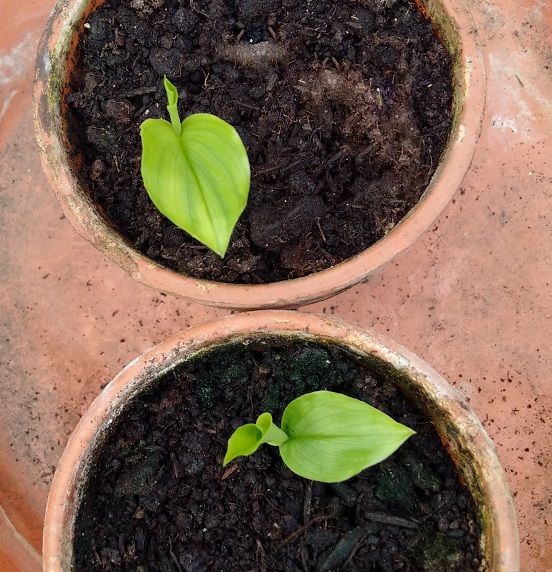
So, all the above happened back in the middle of June. Finally, at the very end of August, I noticed 2 wee green shoots poking out 2 of the pots. Success! I have managed to germinate 2 out of the 5 roots I planted, and this is what they look like just now…….

Fresh_turmeric_plants
New shoots of fresh turmeric. Image copyright: Kathryn Hawkins

As Autumn is on the way, the days are shortening, and the nights are getting cooler, I will have to bring them indoors and try to keep them alive throughout a Scottish winter – apparently it doesn’t survive below 9°C. Fingers crossed….I’ll keep you posted.